Every Man a King
A few days back I was browsing the American Rhetoric top 100 speeches and came across one titled "Every Man A King" by Huey P. Long.
I remembered the name Huey Long from my high school US history class - intrigued I gave it a read. It really is an excellent speech - it captures so succinctly a fundamental question about society and American democracy.
The date 1934 reveals a lot. The 1920s were a time of great expansion in the American economy and an era of glitz, glamour, and highly visible wealth inequality. Everything seemed fine until 1929 stock market crash. Things were not working out for the normal person. In 1932 FDR was elected to his first of four continuous terms. These four terms were transformational. Many of the policies Huey Long campaigned for and built popular support for were passed by FDR in the Second New Deal: Social Security, WPA, NLRB, Wealth Tax.
I love this speech. I deeply admire its construction. It first lays out core values, and then delivers a message appealing to those values. You can see why Huey Long was so persuasive.
The speech opens with a fundamental question:
Is that a right of life, when the young children of this country are being reared into a sphere which is more owned by 12 men that is by 120 million people?
This opening line appeals directly to the listener - asking them to think about it themselves. It's very difficult for any listener to agree that the state described seems reasonable. At the very least there are few people who campaign to persuade people that the state of affairs where a small minority owns a massive share of societies wealth is good for the majority. This state seems especially unreasonable to Huey's listeners, who were struggling.
I contend, my friends, that we have no difficult problem to solve in America
Huey is clever here. In one line he labels wealth inequality as a problem, and tells people it's easy to solve.
It is not the difficulty of the problem which we have; it is the fact that the rich people of this country -- and by rich people I mean the super-rich -- will not allow us to solve the problems, or rather the one little problem that is afflicting this country, because in order to cure all of our woes it is necessary to scale down the big fortunes, that we may scatter the wealth to be shared by all of the people.
Huey breaks up the rich and super rich - to broaden support. Who is 'super rich'? Well that's a matter of the listeners perspective. He implies these 'super rich' are greedy, and are are using their wealth to control society - for their personal benefit and to the detriment of 'the people'.
note: not everyone agrees with Huey - however it's a much more difficult and non-intuitive argument to advocate for wealth inequality. Milton Friedman in Capitalism and Freedom (1962) provides a more nuanced argument that shaped the politics of the 1980s onward.
Huey's prose are especially effective because, in general, America is predicated of the idea of freedom - and the idea that some elite is making decisions or overriding 'the will of the people' goes deeply against American values.
We have a marvelous love for this Government of ours; in fact, it is almost a religion, and it is well that it should be, because we have a splendid form of government and we have a splendid set of laws. We have everything here that we need, except that we have neglected the fundamentals upon which the American Government was principally predicated.
Huey shows his support for and belief in the American system. If only those 'super rich' people gave it a chance to work! Implying the 'super rich' do not believe in the American system and values - enemies of the people!
How may of you remember the first thing that the Declaration of Independence said? It said, "We hold these truths to be self-evident, that there are certain inalienable rights of the people, and among them are life, liberty, and the pursuit of happiness"; and it said, further, "We hold the view that all men are created equal."
Now, what did they mean by that? Did they mean, my friends, to say that all men were created equal and that that meant that any one man was born to inherit $10,000,000,000 and that another child was to be born to inherit nothing?
Did that mean, my friends, that someone would come into this world without having had an opportunity, of course, to have hit one lick of work, should be born with more than it and all of its children and children's children could ever dispose of, but that another one would have to be born into a life of starvation?
Huey brings up a question about inherited wealth and opportunity. He implies people who inherit wealth are lazy and a live off of the hard work of others - and invites the listener to draw this conclusion about rich people in general.
Is this a rational argument? Nope. But Huey isn't trying to make a rational argument - he's trying to build support to accomplish specific goals - and those specific goals require money. Who has the money? Rich people.
Is that, my friends, giving them a fair shake of the dice or anything like the inalienable right of life, liberty, and the pursuit of happiness, or anything resembling the fact that all people are created equal; when we have today in America thousands and hundreds of thousands and millions of children on the verge of starvation in a land that is overflowing with too much to eat and too much to wear? I do not think you will contend that, and I do not think for a moment that they will contend it.
This rhetoric should be familiar to most people today. Huey, is basically saying - given people are struggling - why are the rich leading an 'excessive lifestyle'? Also, remember his previous lines implying the 'super rich' control the government - this implies that the current state of affairs is - in fact - these 'rich peoples' fault!
A fun counter example - or perhaps support for - Huey's narrative are the actions of J. P. Morgan - who helped effectively navigate the US financial system in the panics of 1893 and 1907. J.P. Morgan effectively rallied people to step in - and also profiting immensely. However, J. P. Morgan died in 1913 and no one could effectively play a similar role.
note: this is a fun example of individuals verses systems - when a process relies on an individual - when they are gone it stops - when it relies on a system and culture it can be maintained long term.
The Great Depression and the rise of Keynesian economics fundamentally altered the relationship between the financial system and the US government, and the American People's expectation of government. Instead of relying on individuals the response became systematized.
Now let us see if we cannot return this Government to the Declaration of Independence and see if we are going to do anything regarding it. Why should we hesitate or why should we quibble or why should we quarrel with one another to find out what the difficulty is, when we know what the Lord told us what the difficulty is, and Moses wrote it out so a blind man could see it, then Jesus told us all about it, and it was later written in the Book of James, where everyone could read it?
Huey appeals to common moral religious values. Jesus advocates for the wealthy to build common prosperity by giving to those in need. Huey implies the 'super rich' are unethical, immoral, and acting against gods will.
It's quite challenging to square the values expressed and explicitly called out in the New Testament with with being 'super wealthy'.
We have trouble, my friends, in the country, because we have too much money owing, the greatest indebtedness that has ever been given to civilization, where it has been shown that we are incapable of distributing to the actual things that are here, because the people have not money enough to supply themselves with them, and because the greed of a few men is such that they think it is necessary that they own everything, and their pleasure consists in the starvation of the masses, and in their possessing things they cannot use, and their children cannot use, but who bask in the splendor of sunlight and wealth, casting darkness and despair and impressing it on everyone else.
It's hard to dispute the technical point given the specifics of the Great Depression.
Huey turns the narrative common in this era - the poor's moral failings as the cause of their poverty - into a narrative about how the rich's moral failings are the cause of the poor's poverty.
The next few paragraphs are actually technical garbage - so I've omitted them - however Huey makes the garbage sound reasonable. The fundamental danger is that many ideas seem reasonable - and unless you are well educated to critically think and willing to spend time to do so - it's hard to detect.
If you reduce a man to the point where he is starving to death and bleeding and dying, how do you expect that man to get hold of any money to spend with you?
That's a fair point. I wonder how people react when they are in that situation?
Huey then appeals to authority to support his arguments:
But the Lord gave his law, and in the Book of James they said so, that the rich should weep and howl for the miseries that had come upon them; and, therefore, it was written that when the rich hold goods they could not use and could not consume, you will inflict punishment on them, and nothing but days of woe ahead of them.
God says so!
Then we have heard of the great Greek philosopher, Socrates, and the greater Greek philosopher, Plato, and we have read the dialog between Plato and Socrates, in which one said that great riches brought on great poverty, and would be destructive of a country.
Smart people says so!
It is a very simple process of mathematics that you do not have to study, and that no one is going to discuss with you.
Math says so!
The appeal to math makes me laugh. See Counting by Deborah Stone.
It is necessary to save the Government of the country, but is much more necessary to save the people of America. We love this country. We love this Government. It is a religion, I say.
We must save 'the government' and 'the people'!
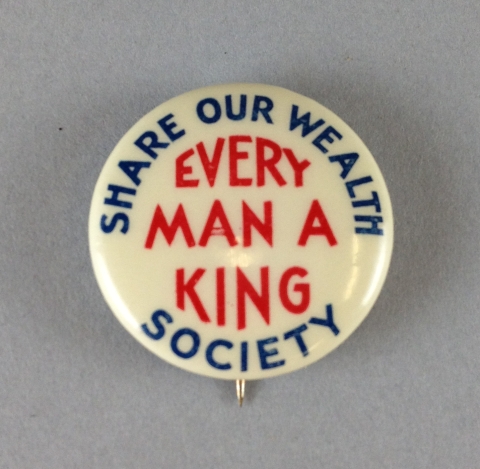
Now, we have organized a society, and we call it "Share Our Wealth Society," a society with the motto "every man a king."
Every man a king, so there would be no such thing as a man or woman who did not have the necessities of life, who would not be dependent upon the whims and caprices and ipsi dixit of the financial martyrs for a living. What do we propose by this society? We propose to limit the wealth of big men in the country.
You can join the movement to save 'the country' and 'the people'! Huey appeals to peoples desire to be part of something greater. Eric Hoffer would be proud.
What is it that Huey actually proposes?
We do not propose to divide it up equally. We do not propose a division of wealth, but we propose to limit poverty that we will allow to be inflicted upon any man's family.
Huey proposes a minimum floor for people to stand on.
Huey's ideas actually materialized in several ways:
- Medicaid - Passed in 1965 by LBJ who was greatly inspired by Huey Long.
- SNAP - Food Stamp Program 1939, Food Stamp Act 1964
We have to limit fortunes.
Progressive Taxation?
Another thing we propose is old-age pension of $30 a month for everyone that is 60 years old.
Social Security? Passed in 1935.
We will limit hours of work. There is not any necessity of having over-production. I think all you have got to do, ladies and gentlemen, is just limit the hours of work to such an extent as people will work only so long as is necessary to produce enough for all of the people to have what they need.
Fair Labor Standards Act of 1938 - minimum wage, overtime pay, no child labor. This law has been revised multiple times.
What exactly do people need? Is there agreement on that? Huey tries to outline a complicated issue (if you reed the full speech). It turns out, peoples conceptualization of what they need is different - so this ends up being politically fraught.
What is overproduction? How does that compare with underproduction? Agricultural underproduction can lead to starvation. Underproduction of other products can lead to other awful consequences. It's a very hard problem to predict how much demand there will be and how much will be produced. Additionally, there is statistical variation in any production system even when trying really hard to control all the variables. Tricky! Arguably, for some products critical to societal stability (like food) it would be a social benefit for the government to subsidize overproduction.
Those are the things we propose to do. "Every man a king." Every man to eat when there is something to eat; all to wear something when there is something to wear. That makes us all sovereign.
You cannot solve these things through these various and sundry alphabetical codes. You can have the N.R.A. and P.W.A. and C.W.A. and the U.U.G. and G.I.N. and any other kind of "dad-gummed" lettered code. You can wait until doomsday and see 25 more alphabets, but that is not going to solve this proposition. Why hide? Why quibble? You know what the trouble is. The man that says he does not know what the trouble is just hiding his face to keep from seeing the sunlight.
God told you what the trouble was. The philosophers told you what the trouble was; and when you have a country where one man owns more than 100,000 people, or a million people, and when you have a country where there are four men, as in America, that have got more control over things than all the 120,000,000 people together, you know what the trouble is.
And we ought to take care of the veterans of the wars in this program. That is a small matter. Suppose it does cost a billion dollars a year -- that means that the money will be scattered throughout this country. We ought to pay them a bonus. We can do it. We ought to take care of every single one of the sick and disabled veterans. I do not care whether a man got sick on the battlefield or did not; every man that wore the uniform of this country is entitled to be taken care of, and there is money enough to do it; and we need to spread the wealth of the country, which you did not do in what you call the N.R.A.
If the N.R.A. has done any good, I can put it all in my eye without having it hurt. All I can see that N.R.A. has done is to put the little man out of business -- the little merchant in his store, the little Dago that is running a fruit stand, or the Greek shoe-shining stand, who has to take hold of a code of 275 pages and study with a spirit level and compass and looking-glass; he has to hire a Philadelphia lawyer to tell him what is in the code; and by the time he learns what the code is, he is in jail or out of business; and they have got a chain code system that has already put him out of business. The N.R.A. is not worth anything, and I said so when they put it through.
National Recovery Administration
Now, my friends, we have got to hit the root with the axe. Centralized power in the hands of a few, with centralized credit in the hands of a few, is the trouble.
Get together in your community tonight or tomorrow and organize one of our Share Our Wealth societies. If you do not understand it, write me and let me send you the platform; let me give you the proof of it.
This is Huey P. Long talking, United States Senator, Washington, D.C. Write me and let me send you the data on this proposition. Enroll with us. Let us make known to the people what we are going to do. I will send you a button, if I have got enough of them left. We have got a little button that some of our friends designed, with our message around the rim of the button, and in the center "Every man a king." Many thousands of them are meeting through the United States, and every day we are getting hundreds and hundreds of letters. Share Our Wealth societies are now being organized, and people have it within their power to relieve themselves from this terrible situation.
Look at what the Mayo brothers announced this week, these greatest scientists of all the world today, who are entitled to have more money than all the Morgans and the Rockefellers, or anyone else, and yet the Mayos turn back their big fortunes to be used for treating the sick, and said they did not want to lay up fortunes in this earth, but wanted to turn them back where they would do some good; but the other big capitalists are not willing to do that, are not willing to do what these men, 10 times more worthy, have already done, and it is going to take a law to require them to do it.
Some of the 'super rich' are ethical and 'socially responsible'. But don't let this fool you! A majority of them are irresponsible and unethical and the law is the only solution.
The Mayo Brothers donated their life savings to create the Mayo Clinic nonprofit to advance medical research and education. This organization has been highly influential in advancing the field of medicine and standard of care across America and the world.
I think this example highlights a fundamental tension. Huey's core argument is that the 'super rich' are being 'socially irresponsible'. Yet, the Mayo Clinic as an institution wouldn't exist without the Mayo brothers accumulating significant wealth and their vision to create such an institution.
Organize your Share Our Wealth Society and get your people to meet with you, and make known your wishes to your Senators and Representatives in Congress.
I thank you, my friends, for your kind attention, and I hope you will enroll with us, take care of your own work in the work of this Government, and share or help in our Share Our Wealth society.
I love this speech. It's a fundamental question about American ideals. How should power be distributed in society? How much power should an individual have? What should we prioritize? How should we go about it? Huey appeals directly to people and asks them to think about it, and to join the movement if they agree with him. He was highly successful, and because of how he structured his movement he built support in society to pass much of the FDRs New Deal legislation.